module 6: august 25-28
Lascia ch’io pianga
why we’re singing this
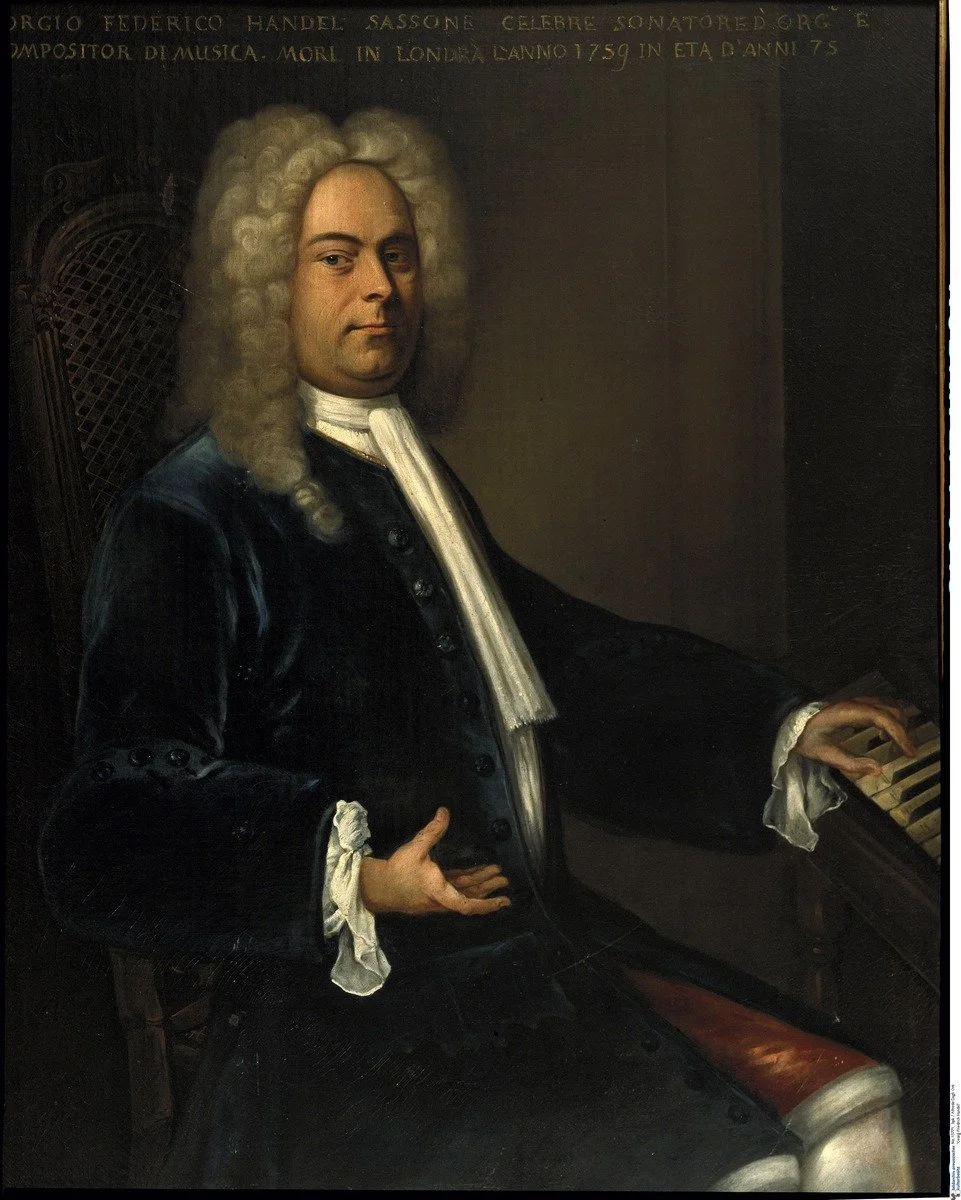
Lascia ch’io pianga is one of Georg Friedrich Händel’s most moving arias: simple in form, yet unbelievably direct in expression. The melody unfolds in long, calm arcs and leaves space for breath and silence—so that every subtle harmonic turn lands with extra impact.
The aria is best known from Händel’s opera Rinaldo (1711), where Almirena sings it as a lament and a longing for freedom and peace. This is Baroque music at its strongest: a clear musical line that carries the text and invites the listener (and singer) to breathe along—through melancholy, surrender, and hope.
Here’s a solo recording, because it captures the original well:
the arrangement
…is designed so that the main melody travels through the different voice groups. No one has the leading role—which means everyone does: we truly sing it together, as one voice.
It’s already special to sing an aria in a five-part SMATB setting and to feel that you’re creating this beautiful music together.
And as the cherry on top, we sing it as a typical sarabande: a triple meter in which every third beat gets a moment of hesitation (a small fermata). That makes it completely different from a waltz, where the length of each beat repeats evenly. This regular-irregular hesitation—together with the text, melody, and harmony—gives the piece ruthless fragility.
That sarabande-hesitation is also what makes this an arrangement for advanced singers: The length of every third beat depends on the conductor, in interaction with whichever voice is carrying the main melody at that moment. So everyone has to pay extremely close attention—and the result is guaranteed ensemble singing instead of sheet staring, making the arrangement and piece feel and sound extra intimate and powerful.
agenda
August 25, 26 & 27
10:00-10:45 group warm-up, vocal technique, vocal expression
10:45-10:55 break
11:00-12:00 rehearsing/learning the song
August 28
10:00-10:45 group warm-up, vocal technique, vocal expression
10:45-10:55 break
11:00-11:30 dress rehearsal
11:45-12:00 concert! You can invite whoever you like.
questions & answers
-
We use three levels: beginner, experienced, and advanced.
Beginner: you have (virtually) no experience with singing lessons, choir singing, or learning music.
Experienced: you have one to a few years of experience with singing lessons, choir singing, or learning music. You can read notes reasonably well, and you can imitate/sing back a melody quite well.
Advanced: you have at least five years of experience with singing lessons, choir experience, and learning music. You can read notes, and you can immediately sing back a melody that is sung to you.
Not sure? Then choose one level lower, or choose two modules in a row—first a lower one, then a higher one.
-
Nothing is mandatory, and you don’t necessarily have to invite an audience.
But… experience shows that sharing your singing—whether with your own audience or with strangers—makes the experience much richer and more meaningful!
Naturally, the conductor will guide you in such a way that you feel minimal stage fright and can enjoy it to the fullest.
-
Basic understanding of English is necessary—but feel free to ask your questions in Dutch or German.
-
In vocal group arrangements, S stands for Sorpano, M for Mezzo-Soprano, A for alto, T for Tenor, B for Bass.
Here’s a Wikipedia article explaining it in detail.
Please note that I work with range, not gender! It’s your actual range that matters, not your pronouns. We figure out the distribution of voices on day 1 of the module.
Always feel invited to ask if you have questions.
-
Don’t worry. On day 1 of each module, we test everyone’s vocal range and distribute voices along the arrangement.
And if that sounds like a foreign language, the short version is: We’ll figure out what best fits your voice when we start a new song/piece.

more singing in the summer!